A live C&I battery with game-changing returns
Business electricity costs in the UK remain high, and tariffs are poorly aligned with how most businesses operate. For many businesses, demand is fixed during the working day, tariffs are archaic, and the cheapest power is available when it cannot be used.
In mid-2025, Capture Energy deployed a behind-the-meter battery at a manufacturing site in South London to test a simple question: can a standalone commercial battery deliver meaningful savings today, without changing how the customer operates?
The answer? A resounding yes. The 260kWh Capture Battery was installed in a single day and reached live operation in under 12 weeks from project start. The system is already delivering savings through tariff arbitrage and flexibility markets and is on track for a sub-4 year payback period even with imperfect electricity tariff structures. This article explains how and why the project was delivered, what we have learned so far, and what else needs to change to unlock even greater savings.


The topic in a nutshell

Most businesses use electricity when it is most expensive and cannot easily shift demand. Tariffs remain outdated and poorly aligned with how businesses actually operate.
By deploying a behind-the-meter battery with strong annual returns, Capture shows that meaningful savings are achievable now, even under standard business tariffs.
Dynamic pricing that reflects wholesale markets and network costs will materially increase returns from batteries. Capture’s upcoming tariff is designed to deliver this.
High bills, no flexibility
Peter operates a precision manufacturing site in South London, running laser cutters and other high-power equipment. Electricity demand is concentrated during weekday working hours and is largely fixed.
The site is on a standard business tariff with cheaper electricity from midnight-7am and a peak rate from 7am onwards. This offered limited benefit in practice and creates a structural cost issue. Consumption is during the expensive daytime periods, while cheaper overnight electricity is unusable due to near-zero night-time demand. Shifting production to access these cheaper rates is not realistic without major changes to throughput or operations.
Traditionally, solar panels on the roof would have been considered. However, the business’ has high usage year round and its roof space too small for any solar to make a meaningful dent in their electricity bills.
As a result, Peter’s electricity costs remained high with few, if any options open to him. This combination of high electricity consumption with limited operational flexibility is typical across UK businesses of all types, and forms the starting point for this project.
Same network, different constraints
While Peter faced high electricity costs with limited flexibility, UK Power Networks (the local DNO) faced a related but distinct challenge. Sharp peaks in demand, typically on weekday afternoons and especially during winter means local substations are increasingly constrained. Upgrade costs can be eye-wateringly expensive and tight supply chains mean wait times for new transformers can be years-long.
To manage this, DNOs tender for ‘Local Flexibility’ services, paying providers to reduce demand during peak periods to support the grid. However, most industrial customers, including this site, cannot realistically shift when they consume electricity without significant operational disruption. Their demand is operationally fixed, even when the network is under the most strain.
An elegant solution that helps the customer and local network
A behind-the-meter battery bridges this gap. It charges when the network has capacity and electricity is cheaper, then discharges during peak periods to reduce site demand. From Peter’s perspective, nothing changes; business continues as usual but instead of drawing from the grid, electricity comes from the battery.
Importantly, while this site sits within a constrained UKPN flexibility zone and is already earning revenue from local flexibility services, this model is not limited to these areas. The GB electricity grid experiences the same ebbs and flows in demand on country-wide level, meaning those with batteries can still generate revenues from national wholesale markets – even if they’re on a standard business tariff.
Delivery speed is the differentiator
Speed was critical to making this project work. From initial project start to commissioning, the full lifecycle took under twelve weeks. No planning permission was required, no grid reinforcement works were needed, and so project development costs were very low. Grid approval was returned in four weeks, reflecting growing recognition from DNOs that flexible assets like batteries can relieve pressure on local networks quickly.
Simple and speedy installation
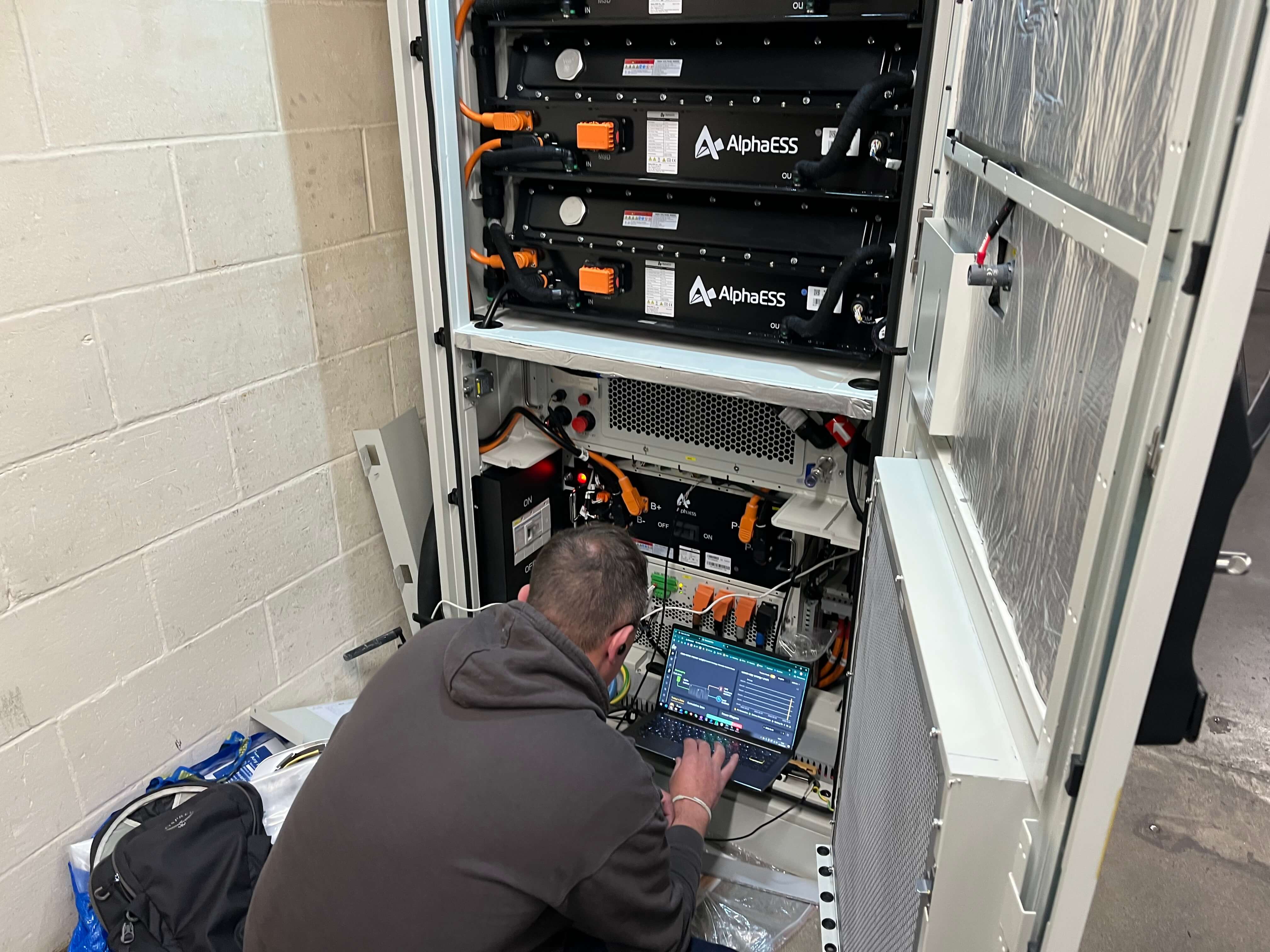
The battery, an Alpha ESS TB125 was delivered to site, installed, and commissioned within a single week of arriving at a UK port.
{{ quote }}
Installation itself happened in a single day. Thanks to the simplicity of all-in-one battery systems, installation and commissioning is far quicker than for similarly-sized solar PV setups. The battery was simply dropped into place by forklift, bolted to the concrete floor and wired in to the property’s existing distribution board. Throughout this process, business operations carried on as usual.
Multiple revenue sources
Despite operating under a standard day/night business tariff, the battery is already delivering a net annual benefit of approximately £10,000 to £12,000, much of this through standard tariff arbitrage.
Crucially, these returns are being achieved without any change to how the site operates, and currently without access to fully dynamic tariffs. This value is generated through a combination of the aforementioned local flexibility revenues, tariff arbitrage, and wholesale market participation. Taken together, these value streams put the project on track for a payback period of around 4 years.
Tariff arbitrage
The battery charges overnight when electricity is cheaper and displaces grid imports during the expensive daytime tariff periods. The price spread is around 7p/kWh, which creates an arbitrage opportunity despite the simple tariff structure. This alone delivers a material share of the annual savings, without requiring any change in operations.
Wholesale market participation
In addition to providing local flexibility to the DNO, the battery also participates in national wholesale day-ahead markets via Capture Energy’s Virtual Trading Party capability. By charging and discharging at specific times of day in response to wholesale price signals, the asset can generate revenues even within the confines of its standard day/night tariff.
This national market exposure means standalone battery economics are not dependent on being located in a specific DNO local flexibility hotspot. It also provides a pathway to further revenue streams as market access and optimisation strategies evolve.
What’s next for Capture
Behind-the-meter batteries are no longer a future solution to sky high electricity costs. This site demonstrates that they work today, delivering double-digit annual savings even under outdated tariff structures.
The real bottleneck is electricity tariff structures. Dynamic access to wholesale and network costs would unlock significantly more value from the same asset, driving down payback periods.
This is why Capture Energy is launching its own dynamic pricing tariff in summer 2026 for businesses with batteries.
The battery is already doing the hard work. The tariff will let it do even more. Get in touch today to join the waiting list.
Batteries are so much simpler to install - no scaffolding, no work on the roof, no long DC cable runs. It just bolts right in.